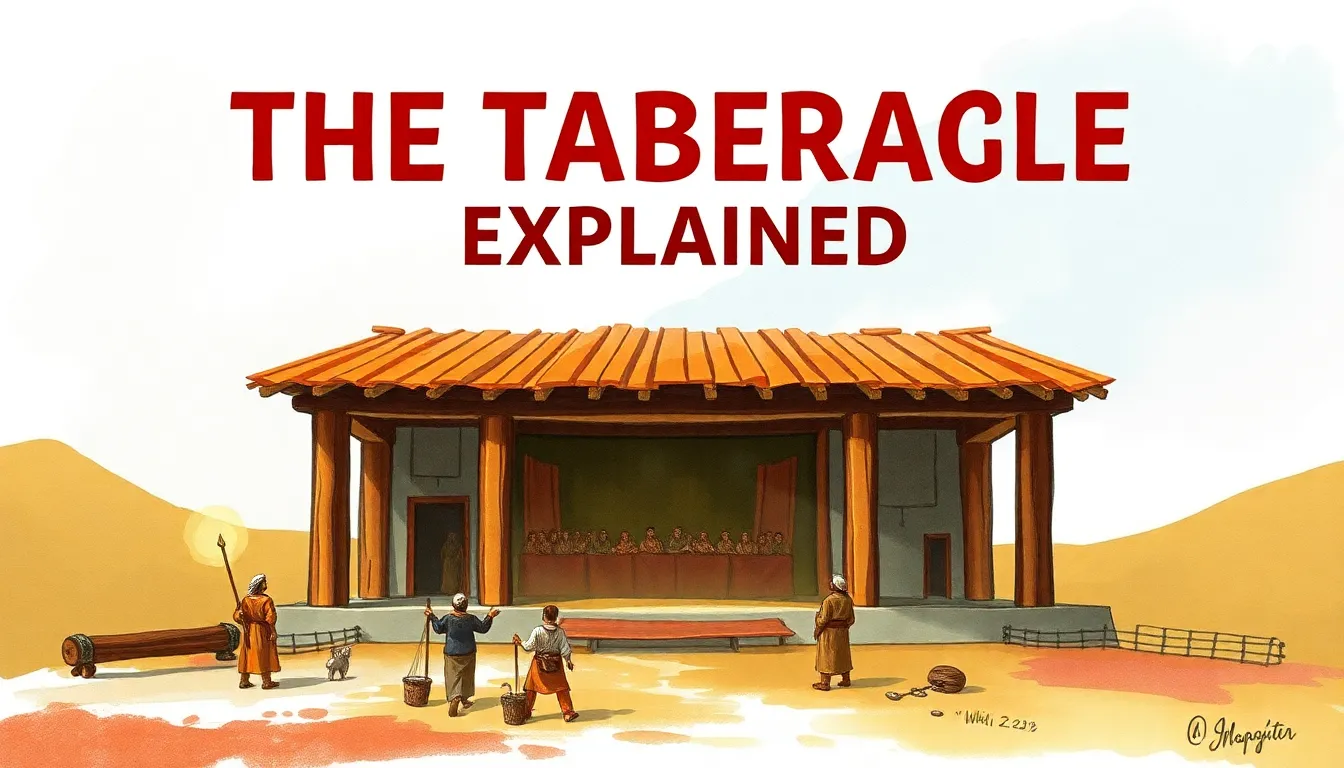
The Tabernacle Explained: Its Structure, Meaning, and Fulfilment in Christ
Exodus devotes more chapters to the tabernacle's construction than to the creation of the entire universe. That proportion is a clue. The tabernacle is not an ancient architectural curiosity — it is a theological masterpiece, and Christ is its fulfilment.
The book of Exodus is structured as two acts. The first act (chapters 1–19) is the story everyone knows: slavery, plagues, Passover, Red Sea, desert. The second act (chapters 20–40) is almost entirely devoted to one subject: the tabernacle. God gives thirteen chapters of precise architectural instruction. Moses executes them in another four. Total: seventeen chapters on a tent.
Why? Because after the thundering revelation of Sinai, the question that drives the second half of Exodus is: how can a holy God dwell among a sinful people? The tabernacle is the answer God provides. It is not furniture — it is a theology in wood, gold, and fabric.
The Three Zones
The tabernacle complex was divided into three areas of increasing holiness, each accessible to a progressively smaller group:
The Outer Court — accessible to all Israelites who came to worship and sacrifice. This was the public face of the tabernacle, containing the bronze altar of burnt offering and the bronze laver (a basin for washing).
The Holy Place — accessible only to priests. This inner chamber held three pieces of furniture: the table of showbread (twelve loaves representing the twelve tribes before God), the golden lampstand (the menorah, providing the only light in this windowless room), and the altar of incense (standing directly before the veil, its smoke representing prayers rising to God).
The Holy of Holies (Most Holy Place) — accessible only to the high priest, only once a year, only with blood. This innermost room held the ark of the covenant — a gold-covered box containing the two stone tablets of the law, Aaron's rod, and a jar of manna. On top of the ark was the mercy seat, where the high priest sprinkled atoning blood on the Day of Atonement. The presence of God himself dwelt between the cherubim above the mercy seat.
The Bronze Altar: Substitutionary Atonement
Before a worshipper could approach God at all, they passed the bronze altar. Here animal sacrifices were offered — the worshipper laid their hand on the animal's head (identifying with it), then the animal was slaughtered in their place. The logic was substitution: the animal's death stood in place of the sinner's death.
This is the pattern that Hebrews 9–10 unpacks as the shadow of Christ's atoning sacrifice. "For it is not possible that the blood of bulls and of goats should take away sins" (Hebrews 10:4) — the animal sacrifices were not the solution; they were the promise of one. Jesus is the Lamb who does not merely represent atonement but accomplishes it.
The Veil: Separation and Access
The thick curtain separating the Holy Place from the Holy of Holies was the most theologically loaded piece of fabric in Israel. It declared: God is present, but you may not enter. The holiness that makes him desirable is also the holiness that makes approach dangerous.
When Jesus died, Matthew 27:51 records: "the veil of the temple was rent in twain from the top to the bottom." The direction is significant — torn from top to bottom, not bottom to top. This was not a human act of protest. It was God opening the way. Hebrews 10:19–20 interprets it directly: "we have boldness to enter into the holiest by the blood of Jesus, by a new and living way, which he hath consecrated for us, through the veil, that is to say, his flesh."
"For Christ is not entered into the holy places made with hands, which are the figures of the true; but into heaven itself, now to appear in the presence of God for us." — Hebrews 9:24
Christ as Every Piece of Furniture
The New Testament writers, particularly the author of Hebrews, read the tabernacle as a comprehensive typology — every element pointing forward to some aspect of Christ's person or work.
- The Door of the Tabernacle → Jesus: "I am the door" (John 10:9)
- The Altar of Burnt Offering → Jesus as our sacrifice (Hebrews 13:10)
- The Laver of Bronze → Baptism; cleansing through the word (Ephesians 5:26)
- The Lampstand → Jesus: "I am the light of the world" (John 8:12)
- The Showbread → Jesus: "I am the bread of life" (John 6:35)
- The Altar of Incense → Christ's intercession; our prayers ascending through him (Hebrews 7:25; Revelation 8:3–4)
- The Ark and Mercy Seat → Christ as the propitiation (Romans 3:25 — the Greek hilastērion is the same word used in the Septuagint for the mercy seat)
John 1:14 and the Dwelling Among Us
"The Word was made flesh and dwelt among us." The Greek word translated "dwelt" is eskēnōsen — literally "tabernacled." John is not reaching for a casual metaphor. He is saying that what the tabernacle represented — God personally present among his people — was fulfilled bodily in Jesus of Nazareth.
The tabernacle was the promise; Jesus is the Person. Understanding the tabernacle doesn't just illuminate the Old Testament — it transforms how you read the Gospels.
Reflection: Consider the movement in the tabernacle from the outer court (public) to the Holy of Holies (most intimate). In your own prayer life, where do you typically spend your time? What would it look like to press through to that most intimate place?
Ready to test your knowledge?
Put what you've read into practice with a Bible quiz — free for every believer.
Build a daily reading habit
Follow a structured plan through the whole Bible — track your progress, day by day.
El Shamarani
Gospel Genius Contributor
Gospel Genius is a Bible knowledge platform helping Christians grow deeper in Scripture through quizzes, daily devotions, reading plans, and study resources. Our contributors are believers passionate about making God's Word accessible to every person.
Learn more about Gospel Genius →