What Is the Hypostatic Union and Why Does It Matter?
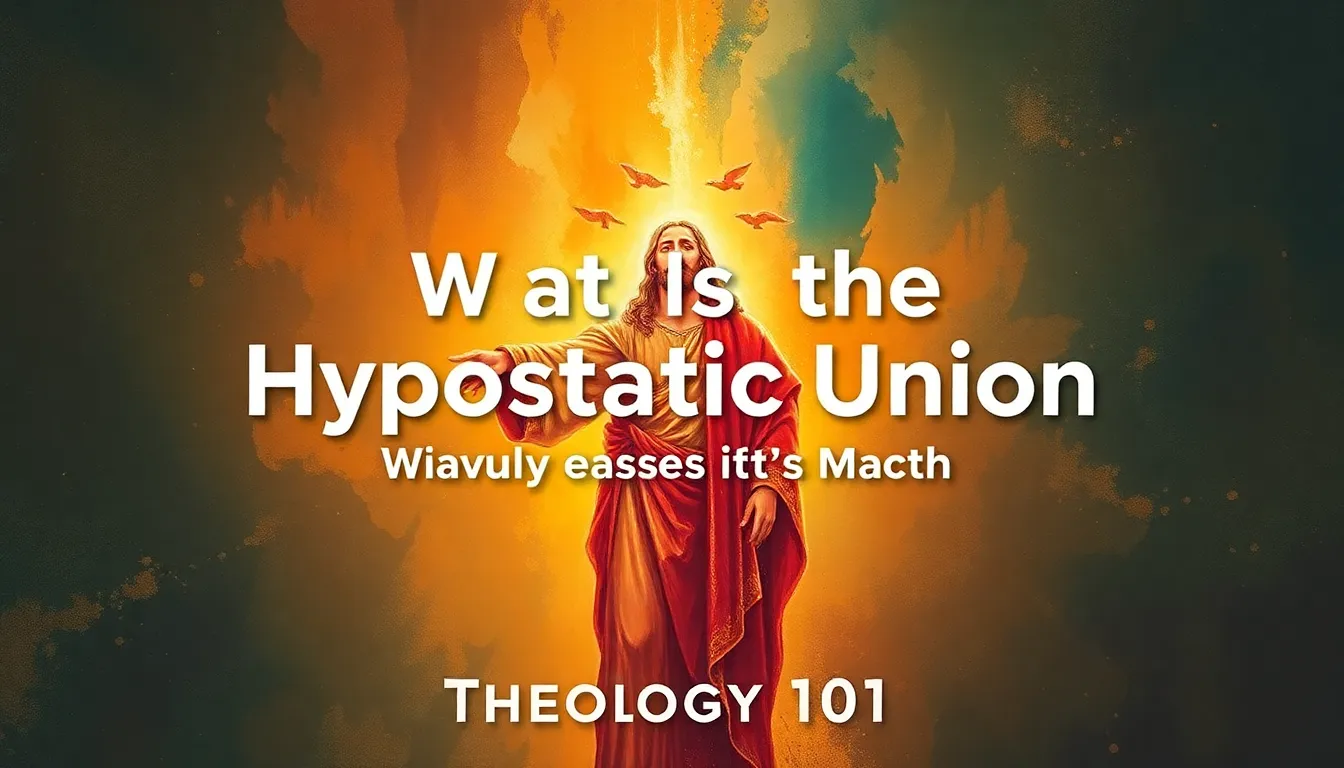
Jesus is fully God and fully human at the same time. This sounds simple until you try to think about it. The church has a technical name for this mystery — and understanding it transforms your view of salvation.
The Mystery at the Centre of Christmas
Every year at Christmas, the church announces something that is either the most extraordinary truth in history or the most extraordinary falsehood: that God became a human being. Not that God appeared to be human. Not that God possessed a human body temporarily. But that the eternal, infinite, all-powerful God took on genuine human nature — complete with hunger, exhaustion, grief, and limitation — and became a real, particular man named Jesus of Nazareth.
The church has a technical term for this: the hypostatic union. It comes from the Greek word hypostasis, meaning "substance" or "personal existence." The doctrine states that Jesus Christ is one divine Person (hypostasis) in two natures — one fully divine and one fully human — without confusion, change, division, or separation.
The Council of Chalcedon (AD 451)
This definition emerged from five centuries of theological wrestling. The church had to fight off two opposite errors. On one side were those who so emphasised Jesus's divinity that his humanity became a kind of costume (Docetism, Apollinarianism). On the other side were those who so emphasised his humanity that his divinity was diminished (Arianism, Nestorianism).
The Council of Chalcedon (451 AD) produced a definition that remains the standard for Catholic, Orthodox, and Protestant Christianity. It declared that Jesus Christ is "truly God and truly man... of one substance with the Father as regards his divinity, and of one substance with us as regards his humanity... acknowledged in two natures, without confusion, without change, without division, without separation."
These four negatives are important: the two natures are not confused into a third thing, nor changed, nor separated, nor divided. They coexist in perfect unity in the one Person of Christ.
Why It Matters: The Logic of Salvation
The hypostatic union is not a theological luxury. It is a soteriological necessity — meaning, the kind of salvation we need requires exactly this kind of Saviour.
First, the Saviour must be genuinely human. The atonement requires that a human being bear the penalty for human sin — someone who is truly "of our kind" (Hebrews 2:14-17). An angel or a spiritual being cannot do this. Jesus had to be genuinely human to represent us.
Second, the Saviour must be genuinely divine. A mere human — however perfect — can only offer a limited atonement, one that might cover his own sin debt but could not offer infinite, cosmic redemption for all who believe throughout all of history. Only an infinite God can make an infinite atonement.
Both natures are required. Jesus is both the perfect human representative who can stand in our place, and the infinite God whose sacrifice has infinite weight.
What This Means in Practice
The hypostatic union means that when you pray, you pray to someone who knows what it is to be tired, to be hungry, to be betrayed, to be tempted. Hebrews 4:15 says Jesus "was in all points tempted like as we are, yet without sin" — and therefore he is a high priest who can sympathise with our weakness.
At the same time, the one who sympathises with your weakness is the one who made galaxies and sustains reality by the word of his power. Your prayers reach someone who is simultaneously the most human person who ever lived and the omnipotent God of creation. That combination is what makes prayer something other than talking to yourself.
Ready to test your knowledge?
Put what you've read into practice with a Bible quiz — free for every believer.
Build a daily reading habit
Follow a structured plan through the whole Bible — track your progress, day by day.
El Shamarani
Gospel Genius Contributor
Gospel Genius is a Bible knowledge platform helping Christians grow deeper in Scripture through quizzes, daily devotions, reading plans, and study resources. Our contributors are believers passionate about making God's Word accessible to every person.
Learn more about Gospel Genius →