Spiritual Disciplines for Busy Nigerians: A Practical Guide
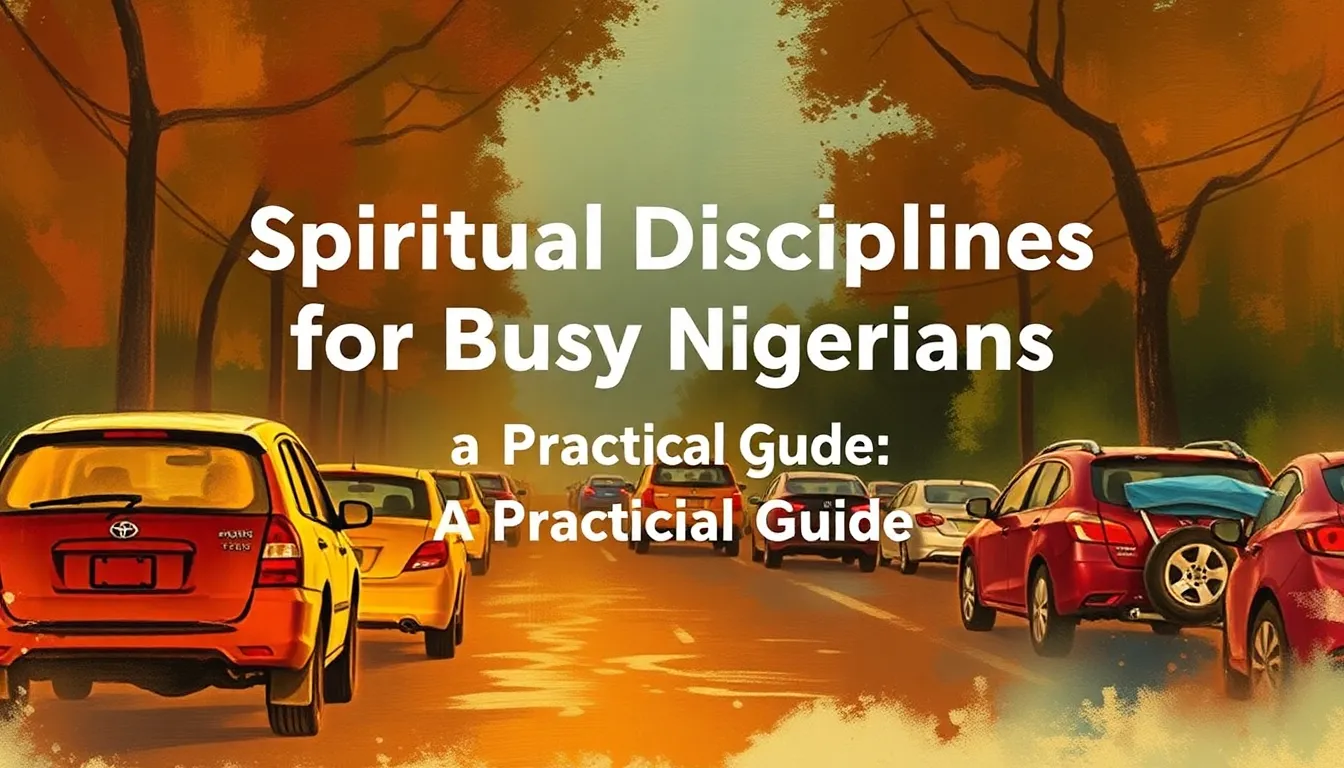
Lagos traffic, long work hours, multiple jobs, and family obligations make the Nigerian schedule uniquely demanding. Here is how to sustain a serious devotional life in the middle of the chaos — specific, realistic, tested.
Spiritual discipline literature is largely written for people with free mornings and quiet homes. It assumes an alarm at 5 a.m. is a feasible option, that a thirty-minute commute is the norm, and that something called a "prayer closet" exists in one's living space.
For many Nigerians, this is not the reality. The Lagos worker wakes before 4 a.m. to beat traffic. The Abuja civil servant attends two churches and a midweek bible study. The market trader in Kano is on her feet from dawn. The student in Enugu shares a room with three others. The entrepreneur in Port Harcourt works seven days a week.
The question is not whether spiritual disciplines are possible in these conditions. They are — but not in the form described in most devotional books. Here is what they can look like in the Nigerian context.
The Goal: Continuity, Not Perfection
The enemy of a sustainable devotional life is the perfectionist expectation that every day must look the same. A missed morning prayer is not a spiritual failure. A week with two good prayer sessions and five poor ones is better than the guilt that abandons the practice entirely because it doesn't look like the YouTube pastor's routine.
Deuteronomy 6 describes spiritual formation as woven into the fabric of daily life — "when you sit, when you walk, when you lie down, when you rise." This is not a schedule. It is an orientation. The goal is God-consciousness distributed through the day, not isolated in a single block.
Bible Reading on Public Transport
The average Lagos commuter spends two to four hours per day in traffic or on the bus. This is not wasted time — it is unstructured time that can be redeemed.
A Bible app with an audio reading feature turns a traffic jam into a passage of Scripture. If you commute forty-five minutes each way by danfo or BRT, you have ninety minutes per day available for audio Bible — enough to complete the entire New Testament in a month.
If reading is possible on your commute, one chapter per trip is sustainable. One chapter in the morning, one chapter in the evening — sixty chapters per month. The habit of reading on commute requires no alarm clock, no quiet room, and no change to your schedule. It requires only a phone and an earpiece.
Praying While Working
The Psalms are full of brief, intense prayers uttered in the middle of activity. Nehemiah 2:4 records the shortest prayer in Scripture: while standing before the king, Nehemiah "prayed to the God of heaven" — a silent moment of urgent supplication before answering the question. The prayer is not recorded. It was enough.
The discipline of breath prayers — short, one-sentence prayers uttered in the middle of work — maintains an awareness of God through the day that cannot otherwise survive a twelve-hour shift. "Lord, give me wisdom for this meeting." "Father, let my hands serve you today." "Help me not to speak impatiently." These are not formal prayer — they are the constant orientation of a heart turned toward God.
"Rejoice evermore. Pray without ceasing. In every thing give thanks: for this is the will of God in Christ Jesus concerning you." — 1 Thessalonians 5:16–18
The Power of One Book
Rather than reading the entire Bible in a year and retaining little of it, consider spending three months in one book. Read Philippians every day for a month. The repetition drives it deep. By week three, you are no longer reading — you are recognising patterns, noticing connections, hearing the argument. You know the book.
For a Nigerian professional who can only manage fifteen minutes per day, one book in depth beats scattered coverage of the whole. Paul wrote to specific people in specific situations. Sitting with his letters long enough to understand the situation transforms abstract doctrine into something you can actually use.
Fasting One Meal Per Week
A full-day fast requires time and planning. But skipping one meal per week — using that time and hunger as a cue to pray specifically — is accessible in virtually any schedule. The hunger pang during your usual lunch hour becomes the reminder: this is prayer time today.
Nigerian Christianity has a rich tradition of fasting. The danger is that fasting becomes a ritual performance — a badge rather than a discipline. The purpose of skipping the meal is not the skipped meal; it is the prayer that replaces it. Even a focused thirty minutes of prayer at lunch in place of eating is a genuine fast if approached with that intention.
Church Community as Accountability
Nigerian Christianity's characteristic strength is community. The house fellowship, cell group, or mid-week meeting is not a programme — it is the relational accountability structure that the New Testament assumes. "Exhorting one another, and so much the more, as ye see the day approaching" (Hebrews 10:25) does not happen in isolation. It requires proximity.
If your schedule makes Sunday the only day you can attend church, make a midweek phone or WhatsApp call to a Christian friend a deliberate practice. Five minutes of accountability — "how is your prayer life this week?" — with one trusted friend does more for spiritual formation than many programmes.
Sunday as a Full Rest Day
Nigerian work culture often treats Sunday as a half-workday: attend church in the morning, work in the afternoon. This slow erosion of rest has spiritual consequences. The Sabbath principle embedded in creation — one day in seven wholly given to rest, worship, and renewal — is not legalism. It is how human beings are built.
One deliberate decision to protect Sunday afternoon — not for work, not for chores that could wait, but for rest, family, and unhurried time with God — changes the texture of the entire week. You cannot sustain spiritual disciplines from an empty tank.
Reflection: Which of the disciplines above is most accessible to your current schedule? Choose one and commit to a specific practice for the next 21 days. Write it down: what you will do, when, and how you will know you have done it.
Ready to test your knowledge?
Put what you've read into practice with a Bible quiz — free for every believer.
Build a daily reading habit
Follow a structured plan through the whole Bible — track your progress, day by day.
El Shamarani
Gospel Genius Contributor
Gospel Genius is a Bible knowledge platform helping Christians grow deeper in Scripture through quizzes, daily devotions, reading plans, and study resources. Our contributors are believers passionate about making God's Word accessible to every person.
Learn more about Gospel Genius →