How to Study the Bible Without Getting Overwhelmed
By Gospel Genius Editorial Team
4 min read
109 views
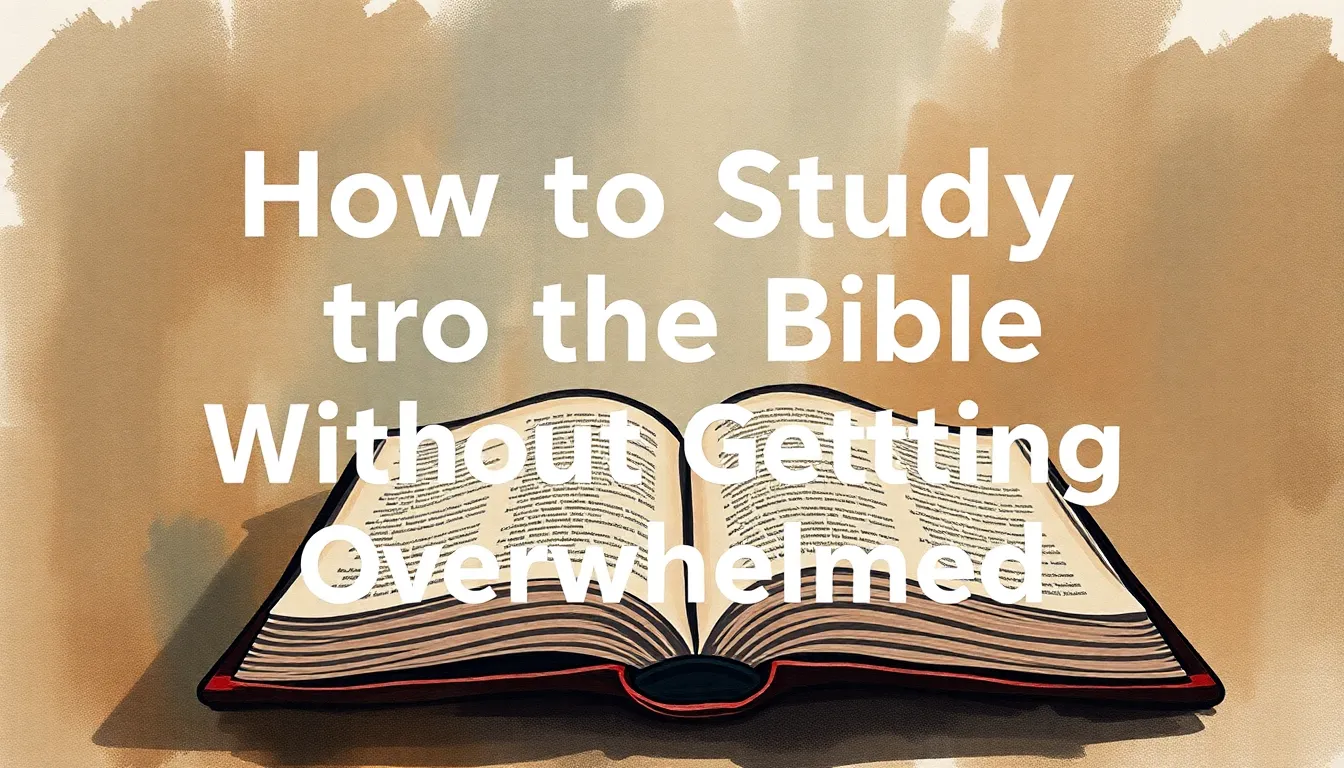
Many Christians want to study the Bible seriously but don't know where to start. Here is a practical, honest guide for readers at every level.
The Bible is 66 books, written over approximately 1,500 years, in three languages, across dozens of genres — poetry, history, prophecy, law, letters, apocalyptic vision. It contains 31,102 verses. For a new believer picking it up for the first time, or for a seasoned churchgoer who has never quite found their way into serious study, the question is not "Is this important?" Everyone agrees it is important. The question is "Where do I begin, and how do I not drown?"
Here is a practical, honest guide.
**Start With the Right Bible Translation**
Not all Bible translations are equal in purpose. The King James Version (KJV) is majestic and accurate but uses Early Modern English that can be a barrier to comprehension for first-time readers. The New International Version (NIV) prioritises readability. The English Standard Version (ESV) balances readability with literal accuracy. The New Living Translation (NLT) is excellent for narrative passages. For serious study, use a word-for-word translation (KJV, ESV, NASB) alongside a thought-for-thought translation (NIV, NLT) so you can compare.
For this platform, we use KJV throughout — partly for its public domain status, and partly because its precision rewards careful reading.
**Don't Start at Genesis 1 (Unless You're Ready)**
Many people make the same mistake: they decide to read the Bible "properly" and start at Genesis 1. They get through the exciting narratives of Genesis and Exodus, begin to slow in Leviticus, stall completely in the census lists of Numbers, and give up before Joshua. This does not mean they are weak. It means they started in the wrong place.
For new readers, start with the Gospel of Mark. It is the shortest Gospel, the most action-packed, and gives you the clearest picture of who Jesus is in the shortest amount of time. Then read Luke and Acts as a two-part story. Then read John. By the time you have read all four Gospels, you have the interpretive key to the entire rest of the Bible.
For experienced believers who want depth, start with a single book and go deep rather than covering more ground quickly. Spend a month in Romans. Read every verse, look up cross-references, and ask three questions of every passage: What does this say about God? What does it say about humanity? What does it require of me?
**The Three Essential Questions**
Bible study becomes manageable when you build it around a simple framework. For every passage you read, ask:
1. **What does it say?** (Observation) — Read carefully. Look for repeated words, contrasts, commands, promises. Who is speaking? To whom? What is the context?
2. **What does it mean?** (Interpretation) — What did this mean to the original audience? What literary genre is this — poetry, law, prophecy, history, epistle? The genre shapes how you interpret the content.
3. **What does it mean for me?** (Application) — Given what this passage reveals about God and about human nature, what changes in how I think, act, or pray?
**Use a Study Bible**
A good study Bible is one of the wisest investments a believer can make. The ESV Study Bible and the NIV Study Bible both have extensive footnotes, cross-references, and introductions to each book. When a passage confuses you, the footnotes often answer the question immediately, or at least point you in the right direction.
**Read Books, Not Verses**
Social media Christianity has trained many believers to consume the Bible as a collection of individual verses — each one a standalone motivational quote. This can distort meaning profoundly. "I can do all things through Christ which strengtheneth me" (Philippians 4:13) is not a general promise of success in every endeavour. In context, it is Paul describing contentment in both abundance and want. The verse is powerful — but only when understood in context.
Train yourself to read whole paragraphs, chapters, and books before extracting applications. The meaning of any verse is shaped by the verses around it, the chapter it is in, the book it belongs to, and the position of that book in the whole sweep of Scripture.
**Make It Personal Without Making It Private**
Bible study done in community is richer than Bible study done alone. A home Bible study group, a discipleship relationship, a Sunday school class — these are the spaces where your interpretation gets checked, your blind spots get exposed, and your insights sharpen through dialogue. The Reformers talked about the perspicuity of Scripture — the clarity of its central message. But that does not mean every passage is equally clear, or that your first reading is always correct. Submit your understanding to the community of believers.
**A Word to Those Who Feel Behind**
If you are a believer who has been in the Church for twenty years and still feels like you don't know the Bible well, this is for you: it is never too late. The disciples who walked with Jesus for three years still didn't fully understand the Scriptures until after the resurrection, when "he opened their understanding, that they might understand the scriptures" (Luke 24:45). Understanding is a gift, not a performance. Ask for it. Then open the Book.
Here is a practical, honest guide.
**Start With the Right Bible Translation**
Not all Bible translations are equal in purpose. The King James Version (KJV) is majestic and accurate but uses Early Modern English that can be a barrier to comprehension for first-time readers. The New International Version (NIV) prioritises readability. The English Standard Version (ESV) balances readability with literal accuracy. The New Living Translation (NLT) is excellent for narrative passages. For serious study, use a word-for-word translation (KJV, ESV, NASB) alongside a thought-for-thought translation (NIV, NLT) so you can compare.
For this platform, we use KJV throughout — partly for its public domain status, and partly because its precision rewards careful reading.
**Don't Start at Genesis 1 (Unless You're Ready)**
Many people make the same mistake: they decide to read the Bible "properly" and start at Genesis 1. They get through the exciting narratives of Genesis and Exodus, begin to slow in Leviticus, stall completely in the census lists of Numbers, and give up before Joshua. This does not mean they are weak. It means they started in the wrong place.
For new readers, start with the Gospel of Mark. It is the shortest Gospel, the most action-packed, and gives you the clearest picture of who Jesus is in the shortest amount of time. Then read Luke and Acts as a two-part story. Then read John. By the time you have read all four Gospels, you have the interpretive key to the entire rest of the Bible.
For experienced believers who want depth, start with a single book and go deep rather than covering more ground quickly. Spend a month in Romans. Read every verse, look up cross-references, and ask three questions of every passage: What does this say about God? What does it say about humanity? What does it require of me?
**The Three Essential Questions**
Bible study becomes manageable when you build it around a simple framework. For every passage you read, ask:
1. **What does it say?** (Observation) — Read carefully. Look for repeated words, contrasts, commands, promises. Who is speaking? To whom? What is the context?
2. **What does it mean?** (Interpretation) — What did this mean to the original audience? What literary genre is this — poetry, law, prophecy, history, epistle? The genre shapes how you interpret the content.
3. **What does it mean for me?** (Application) — Given what this passage reveals about God and about human nature, what changes in how I think, act, or pray?
**Use a Study Bible**
A good study Bible is one of the wisest investments a believer can make. The ESV Study Bible and the NIV Study Bible both have extensive footnotes, cross-references, and introductions to each book. When a passage confuses you, the footnotes often answer the question immediately, or at least point you in the right direction.
**Read Books, Not Verses**
Social media Christianity has trained many believers to consume the Bible as a collection of individual verses — each one a standalone motivational quote. This can distort meaning profoundly. "I can do all things through Christ which strengtheneth me" (Philippians 4:13) is not a general promise of success in every endeavour. In context, it is Paul describing contentment in both abundance and want. The verse is powerful — but only when understood in context.
Train yourself to read whole paragraphs, chapters, and books before extracting applications. The meaning of any verse is shaped by the verses around it, the chapter it is in, the book it belongs to, and the position of that book in the whole sweep of Scripture.
**Make It Personal Without Making It Private**
Bible study done in community is richer than Bible study done alone. A home Bible study group, a discipleship relationship, a Sunday school class — these are the spaces where your interpretation gets checked, your blind spots get exposed, and your insights sharpen through dialogue. The Reformers talked about the perspicuity of Scripture — the clarity of its central message. But that does not mean every passage is equally clear, or that your first reading is always correct. Submit your understanding to the community of believers.
**A Word to Those Who Feel Behind**
If you are a believer who has been in the Church for twenty years and still feels like you don't know the Bible well, this is for you: it is never too late. The disciples who walked with Jesus for three years still didn't fully understand the Scriptures until after the resurrection, when "he opened their understanding, that they might understand the scriptures" (Luke 24:45). Understanding is a gift, not a performance. Ask for it. Then open the Book.
Ready to test your knowledge?
Put what you've read into practice with a Bible quiz — free for every believer.
Build a daily reading habit
Follow a structured plan through the whole Bible — track your progress, day by day.
Tags:
Bible study
how to read the Bible
Scripture
Christian living
faith
G
Gospel Genius Editorial Team
Gospel Genius Contributor
Gospel Genius is a Bible knowledge platform helping Christians grow deeper in Scripture through quizzes, daily devotions, reading plans, and study resources. Our contributors are believers passionate about making God's Word accessible to every person.
Learn more about Gospel Genius →